Filling machine selection
Compare volumetric filling with peristaltic, pump, weight, vacuum and other dosing routes.

Four‑nozzle automatic piston filler for honey, sauce, cream and lotion. Choose the appropriate cylinder module for your fill size.
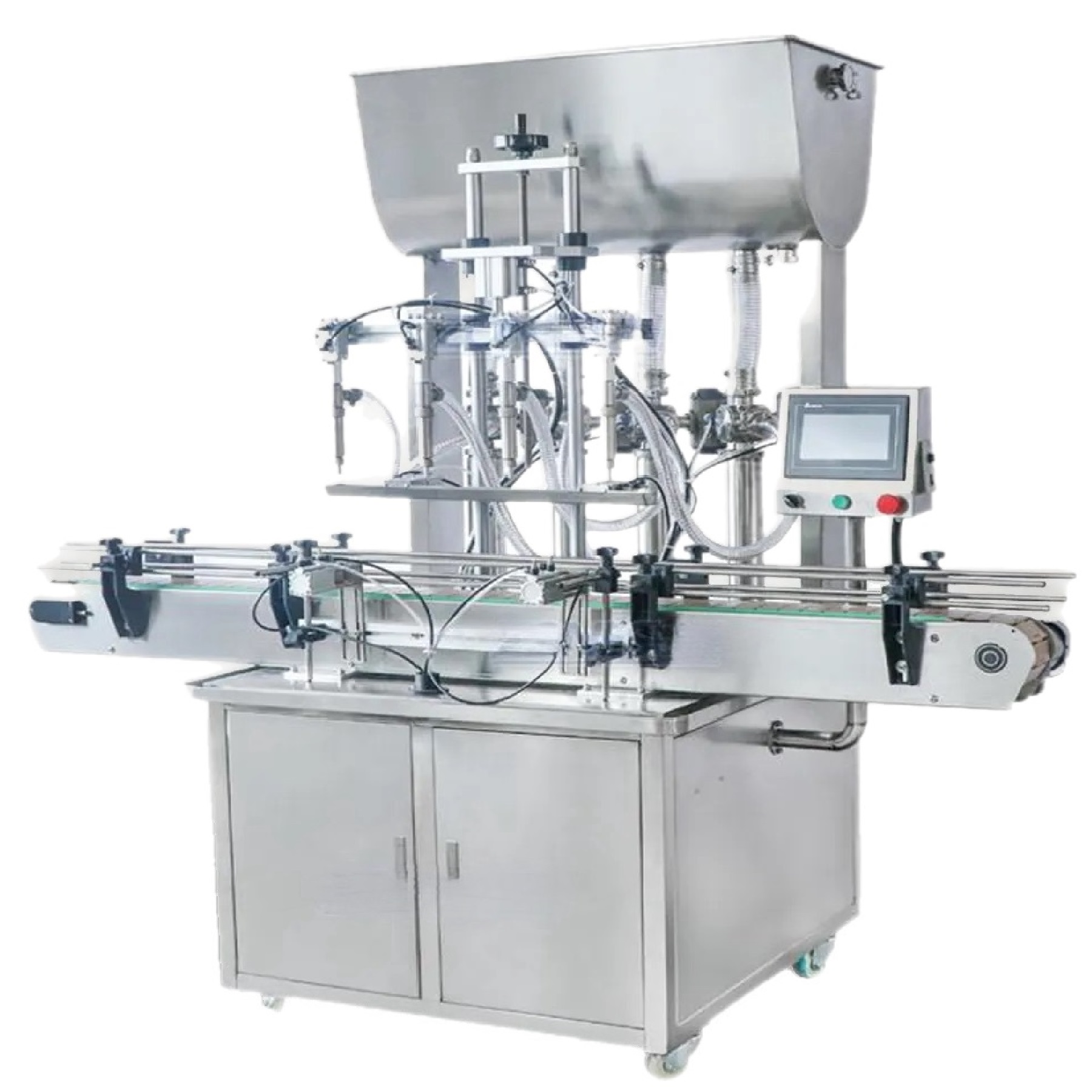
Compact footprint with strong throughput.
5–100 / 10–300 / 50–500 / 100–1000 / 500–3000 / 1000–5000 ml.
Clean finishes and less rework.
Simple numeric volume entry.
Reliable auto cycle and less spillage.
Food/beauty friendly surfaces.
Performance depends on product, container, and setup. Ask us for a timed trial.
Honey, sauces, condiments.
Creams, lotions.
Detergents and gels.
Application and selection guidance
This four-head piston volumetric filler is presented for products such as honey, sauces, creams and lotions. Final configuration should be based on the product at filling temperature, the required volume module and the production container.
A piston draws a measured volume of product and discharges it through the filling nozzle. The selected cylinder module establishes the practical dose range, while the machine controls the filling cycle and container indexing.
The published module range on this page extends from 5–100 ml through to 1000–5000 ml. That does not mean one cylinder covers the whole range; the suitable module must be selected for the required doses.
Viscosity, temperature, strings, particulates and trapped air can affect cut-off and repeatability. Supply the smallest neck opening, the least stable container and the product at the temperature used in production.
Anti-drip nozzle design, nozzle bore and filling height should be reviewed from samples, particularly where the product can foam, bridge or mark the neck.
Define every fill volume and container size so that cylinder selection, nozzle spacing, guide adjustment and recipe changes are understood. If a heated hopper or mixer is being considered, state why it is needed and the operating temperature or agitation requirement.
Product-contact parts must be accessible for the intended cleaning method. The cleaning brief should identify whether product is changed between batches, how frequently the line is cleaned and which components need removal.
For an automatic line, provide the upstream container supply and downstream capping or labelling requirements. Conveyor height, bottle spacing and control signals should be agreed as part of the line specification.
A peristaltic filler may be considered where keeping liquid within replaceable tubing is a priority. A gear pump filler may suit a different flow profile, while products sold by net mass may justify a weight-filling review.
Send the product and the full container range so the piston module and nozzle arrangement can be reviewed.
Request a volumetric filling reviewThe page lists several volumetric cylinder modules. The correct module or modules must be selected for the required dose range; one cylinder should not be assumed to cover all listed volumes.
No. Repeatability depends on product consistency, dose, temperature, air, particulates, nozzle cut-off and setup. The required tolerance should be confirmed in a trial using the agreed product and container.
A heated hopper or other option may be considered where supported by the application, but the product temperature, contact materials and cleaning method must be reviewed before specification.
Nozzle design, product temperature, filling speed, shut-off timing and the product’s tendency to string all affect cut-off. A sample test is needed for difficult products.
Yes, subject to a coordinated conveyor, product spacing, transfer height and control interface. The complete line rate should be based on the slowest proven station.
Volumetric filler project resources
The existing machine information describes this automatic volumetric filler. The following project checks help turn that starting point into a controlled application trial and connected-line specification.
Supply the lowest and highest fill, the product at its real filling temperature and the containers with the smallest opening or least stable base. Record whether particles, aeration, foaming, strings or settling occur during normal production. The required cylinder or dosing range, nozzle arrangement and product supply should be reviewed together rather than selected from nominal volume alone.
Define the approved fill result and the measurement method. Include container detection, no-container/no-fill response, drip control, product recovery and the effect of stops or low product level. Where the filler connects to a capper or labeller, agree conveyor height, direction, spacing and blocked/starved signals before build.
Compare volumetric filling with peristaltic, pump, weight, vacuum and other dosing routes.
Prepare representative product, containers, measurement and retained evidence.
Define transfers, accumulation, signals, faults and downstream handover.
Ready to discuss the application?
Send the application details to Lancing for a tailored machinery review.
Volumetric filling questions
A volumetric filler should be assessed under controlled product and container conditions. These questions help distinguish dosing behaviour from supply, nozzle and handling effects before acceptance criteria are fixed.
Record the product temperature at the point of filling and keep it within the range expected in production. Temperature can change flow, viscosity, foaming and the way a product cuts off at the nozzle, so an unrecorded warm or cold sample can make the trial unrepresentative.
Document how the product is prepared, stored, mixed and supplied to the machine. Where temperature changes during a run, take observations at defined intervals rather than treating the first successful fills as the whole result.
The filling variation guide explains related causes.
Observe the nozzle across the intended dose and speed range using the actual product temperature and container opening. Confirm the cut-off, delay, nozzle movement and any suck-back or shut-off action without relying on a clean-water demonstration.
Check strings or droplets on the container neck, conveyor and following pack, including after stops and restarts. Product build-up over a longer run may reveal a condition that a few test cycles do not show.
Use the trial guide to define observations.
An unstable or incorrectly positioned container can change nozzle entry, splash, product loss or the timing of the fill signal. The dosing system may repeat correctly while the measured finished pack varies because product is left on the neck or lost during transfer.
Check bottle detection, stop position, guide pressure, conveyor movement and the transition out of the fill station. Use filled-pack measurements together with observations of the dosing cycle so handling losses are not mistaken for calibration drift.
For interfaces, see the line-integration guide.
Acceptance checks should cover the agreed products, dose range, containers, operating condition, changeover, start-up, stop/restart, cleaning access and the method used to judge finished fills. The test duration and sample selection should be defined before the run.
Separate machine-cycle observations from finished-pack verification and record any excluded conditions. Where the site uses downstream weighing or inspection, include the data interface and response to a failed result in the scope.
The FAT and SAT guide helps structure acceptance.
Supply representative product and containers, the operating temperature, dose range and acceptance method so the proposed volumetric configuration can be tested on the real duty.
Discuss the applicationVolumetric filling and pack control
The volumetric dosing principle should be trialled with the actual product temperature, particles or aeration, fill range and smallest container opening. Container stability and the packer's measurement system can change the accepted configuration even where the dosing mechanism is unchanged.
Filling-method clarification
A volumetric filler controls a calibrated volume or displacement; the resulting weight depends on product density and process conditions. Where the commercial or legal target is mass, define how density, finished-pack checks and any weight-control loop will be handled.
Compare volume control, weight control, tare and trial evidence.
Review the packer’s filling and checking responsibilities.
Use representative product, containers and measurement methods.
© Copyright 2025 by Lancing Ltd - all right reserved terms & conditions