Filling technology comparison
Compare product-contact, cleaning and dose considerations across filling principles.

Servo‑controlled peristaltic filler with touch HMI. Dosing volume is set directly on the screen—no need to time the fill. Four peristaltic channels keep product inside disposable tubing for rapid changeovers.
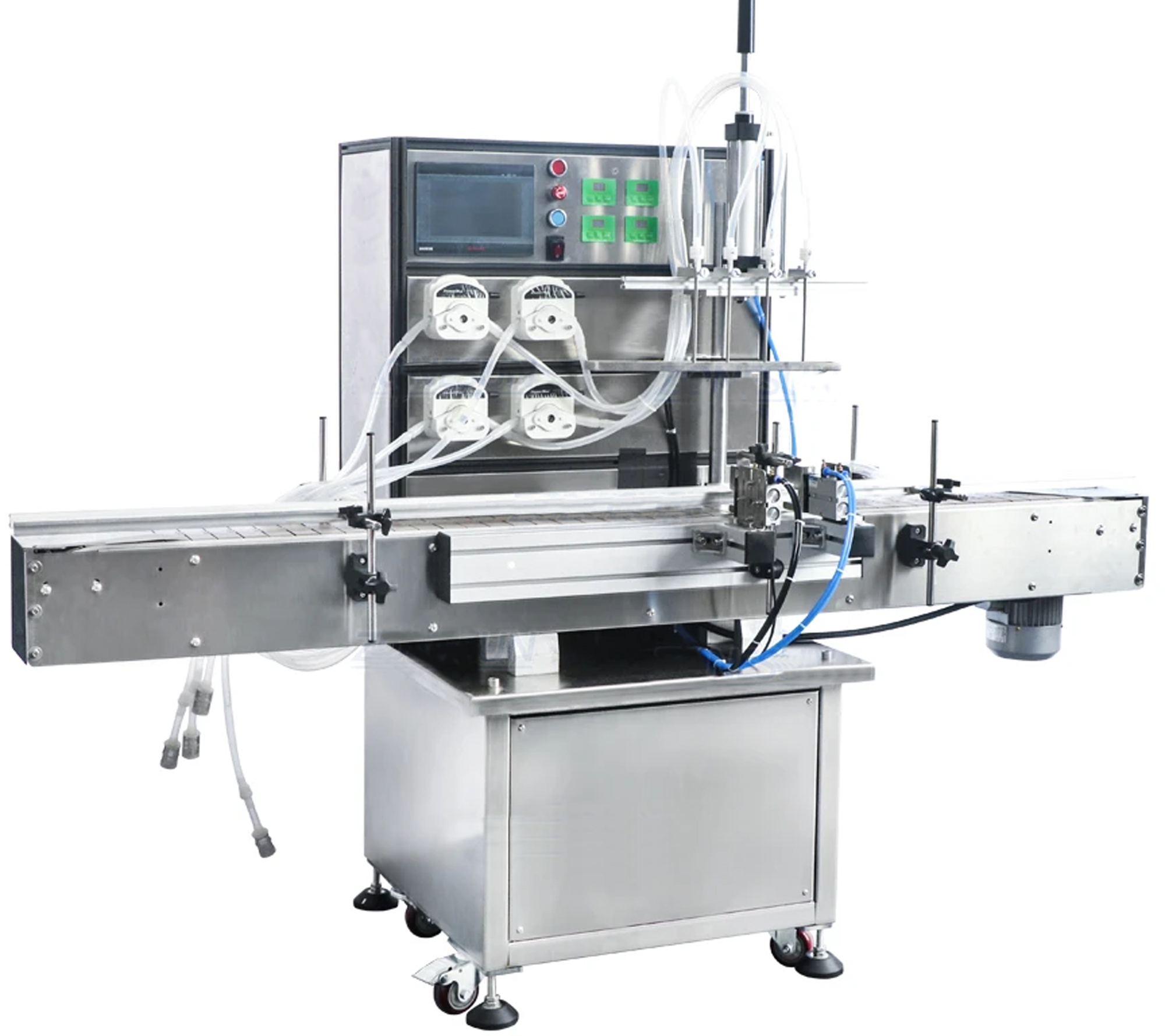
Servo control sets volume without timing—quicker recipe changes.
Liquid only contacts the hose; swap tubing for changeovers.
Suitable for small bottles and healthcare liquids.
Throughput varies by product and dose.
Configure heads to match your rate today and tomorrow.
Stable transfer and automatic bottle detection.
Performance depends on product, container, and setup. Ask us for a timed trial.
Skin toner, perfume make‑up removers.
Energy shots and small PET bottles.
Solvents and reagents (compatibility dependent).
Tell us about your application. We’ll confirm compatibility and quote the best configuration.
Application and selection guidance
The automatic peristaltic filler shown on this page uses four channels and touchscreen volume entry. Product remains within the tubing, making tubing compatibility, pump-tube life and the required dose central to the application review.
Rollers compress flexible tubing to move the liquid. The pump mechanism does not need to contact the product, so a product change can be managed by replacing or cleaning the tubing path as appropriate.
Tubing is a working component. Its material, bore, wall thickness and condition influence delivery, so the intended liquid and cleaning process must be checked against the selected tube.
The page states a maximum flow reference of 2.4 litres per minute across each of four channels and a reference of 10–20 bottles per minute at 100 ml. Actual output changes with dose, liquid, tubing, acceleration, container indexing and nozzle movement.
Use a timed trial with the production liquid and container when the required rate is commercially important.
Provide the full bottle range, especially the smallest neck and lightest container. Nozzle position, bottle detection and conveyor guides must prevent splashing and maintain a repeatable fill point.
The visible model reference is LUSVPP80C. Recipe entry on the HMI can simplify changes between established doses, but each recipe still needs to be validated with the selected tubing and liquid. A wide dose range may require more than one tube size or pump arrangement.
For viscous products, large particles or very large doses, compare the flow path and cycle time with piston volumetric filling or gear pump filling. Where net mass is the controlling requirement, review weight filling.
Confirm the liquid, dose and tubing together before finalising the pump configuration.
Request a peristaltic filling reviewThe product is conveyed inside flexible tubing, so it does not need to contact the pump rollers or pump body. The tube itself remains a product-contact component.
Tube life depends on material, bore, pump setting, liquid, cleaning and operating time. It should be treated as an application-specific consumable and verified during trials and maintenance planning.
The entered value simplifies setup, but the delivered volume should still be checked with the selected liquid, tube and operating conditions before production.
Suitability depends on viscosity, tubing, required dose and rate. Thick or particulate products may be better assessed with a piston or other positive-displacement system.
The page notes that head count can be configured. The required number should be based on the proven flow per channel, indexing time and target line output.
Peristaltic filling project resources
Peristaltic filling isolates the product within the tube path, but tube material, bore, compression, routing and service condition still influence the result.
Provide the actual liquid, operating temperature, dose range and any sensitivity to shear, aeration or contamination. Confirm the proposed tubing against the product and cleaning regime, and include tube installation, priming, replacement and disposal in the operating method. The trial should assess the complete range rather than extrapolating one dose across every tube and speed condition.
Record the accepted measurement method, the sequence after tube replacement and the checks needed after a stop. For multi-channel use, verify channel-to-channel results with the proposed product supply and container presentation. Where another dosing technology may be more suitable, compare the contact path, cleaning, dose range and sustained production requirement rather than product name alone.
Compare product-contact, cleaning and dose considerations across filling principles.
Plan tubing replacement, priming, line clearance and first-off release.
Set representative conditions and measurable acceptance criteria.
Ready to discuss the application?
Send the application details to Lancing for a tailored machinery review.
Peristaltic filling application detail
Peristaltic filling isolates the product within the selected tubing path, but tubing material, size, condition and replacement method remain part of the application. Confirm the smallest dose, liquid behaviour, nozzle cut-off, bottle opening, container detection and the packer's measurement method using production samples.
© Copyright 2025 by Lancing Ltd - all right reserved terms & conditions