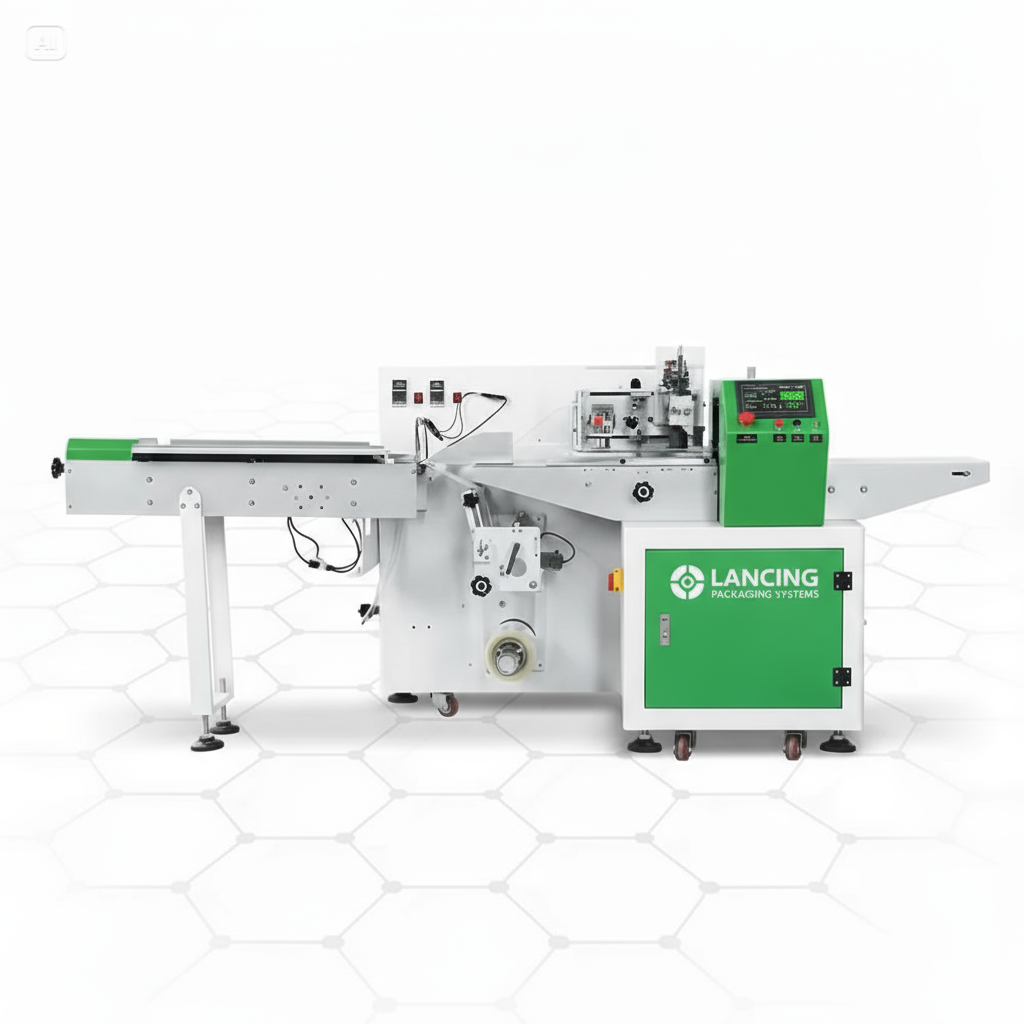
Wrapping and sealing selection
Choose the process from the finished pack, product and film.

Flow-wrapping guidance
A flow wrapper forms a continuous film tube around products and creates longitudinal and end seals. Product dimensions, spacing, film, seal position and infeed method determine the practical configuration.
Rigid products can often be indexed directly, while soft, irregular or sticky items may need guides, carriers or a tailored infeed. The product must arrive at a repeatable pitch so that the end jaws seal between packs.
Confirm the film construction, width, roll dimensions, seal temperature window and whether graphics need print-mark registration. The fin-seal position and end-seal appearance should be agreed from samples.
Provide minimum and maximum product length, width and height, including normal variation. The widest product does not always create the most difficult pack: short products can challenge jaw timing, and flexible products can move as the film is formed.
For automatic feeding, explain how products leave the upstream process. For manual loading, define the operator rate and safe loading area. Downstream coding, inspection, cartoning or case packing should be included in the line layout.
See the flow wrapping machine page for a current equipment example.
Confirm the product pitch, film and seal position before selecting a wrapper.
Review a flow-wrap applicationFlow wrapping can suit many individual products and multipacks, provided they can be presented consistently and the film can form and seal around them. Samples are required for irregular or flexible products.
Film width is based on the product cross-section, the forming path and the required longitudinal seal. The exact value should be confirmed from the product and machine configuration.
Yes, where the machine is configured for print-mark registration and the printed repeat matches the pack length and seal positions.
Infeed consistency, product pitch, bag length, jaw motion, film sealing window and downstream handling all affect sustainable output.
Shrink wrapping can be preferable for grouped transit packs or products that do not need closely registered end seals. The required pack appearance and protection decide the better process.
Flow-wrapping planning
A flow wrapper relies on controlled infeed and a film structure that can track, form and seal around the real product without contamination or damage.
Provide the full product range, orientation, spacing, fragility and approved finished pack. Supply production reels with film structure, thickness, width, core, reel diameter, print registration and winding direction. Define fin-seal and end-seal positions, code area and the checks used to approve the pack.
The wrapping and sealing guide distinguishes flow wrapping from shrink wrapping, L-sealing, VFFS, pouch and band-sealing processes. Use the sample trial guide to plan enough product and film for threading, setup, heat stabilisation and evidence runs.
Choose the process from the finished pack, product and film.
Coordinate print registration and verification with the film web.
Plan product pitch, ready signals, faults and protected discharge.
Ready to discuss the application?
Send the application details to Lancing for a tailored machinery review.
Flow-wrapping questions
A horizontal flow wrapper must control product spacing, film travel and sealing as one timed process. These questions help identify whether a flow wrapper is suitable and what must be demonstrated with the intended product and film.
Product length defines the physical space needed inside the pack, while pitch includes the clearance and film length required for the cross-seal cycle. Variable or uncontrolled pitch can move a product into the seal jaws or create inconsistent pack length.
Describe the smallest and largest product, orientation, spacing method, surface friction and whether products arrive continuously, in groups or by manual loading. The infeed must establish a repeatable relationship between product and film registration.
For line interfaces, use the packaging-line integration guide.
Flow wrapping normally moves a product horizontally through film that is formed and sealed around it. Vertical form fill and seal normally forms a bag vertically and receives a measured product dose before the top seal is made. The correct process follows the product presentation and dosing route.
Products that must remain in a set orientation often suit horizontal handling; loose powders, granules or liquids may require a dosing system above a vertical bag maker. Film, seal style, pack shape and loading method should be compared together.
Read the full flow wrap, shrink wrap and VFFS comparison.
Seal-jaw contamination can prevent the film layers from receiving consistent heat and pressure across the intended seal. Crumbs, powder, liquid, grease or product tails may be trapped only on some cycles, which makes the fault appear intermittent.
Investigate the product position and cut-off timing before increasing temperature. Higher heat cannot compensate reliably for material trapped in the seal and may damage film or product. Record the failed pack, product position and machine state when the fault occurred.
Use the seal failure troubleshooting guide.
Agree who or what creates the required product orientation and pitch at the wrapper infeed. Manual loading depends on safe access, operator reach and a realistic sustained work pattern; automatic loading depends on an interface that presents each product at the correct time and condition.
The acceptance test should use the intended loading method. A wrapper demonstration with hand-spaced perfect products does not prove the performance of an upstream automatic feed or a production operator over a normal run.
The automation-level guide helps define operator content.
Provide representative products, the intended film, required pack style, loading method and finished-pack examples before selecting a flow-wrapping configuration.
Discuss the applicationFlow-wrap material specification
Flow-wrapper trials should use production-equivalent film with the final web width, print repeat, registration and sealant construction. Define the product's dimensions, spacing, orientation, heat sensitivity and contamination risk, then assess starts, stops and splices as well as steady running.
© Copyright 2025 by Lancing Ltd - all right reserved terms & conditions