Powder and granule filling selection
Compare auger, vibratory and weight-based routes against product behaviour.

Automatic auger filler with conveyor and integrated weighing device. Run by weight or pulse counts; hopper with mixer maintains consistent flow. Typical output ≈30–45 bpm (10–2000 g).
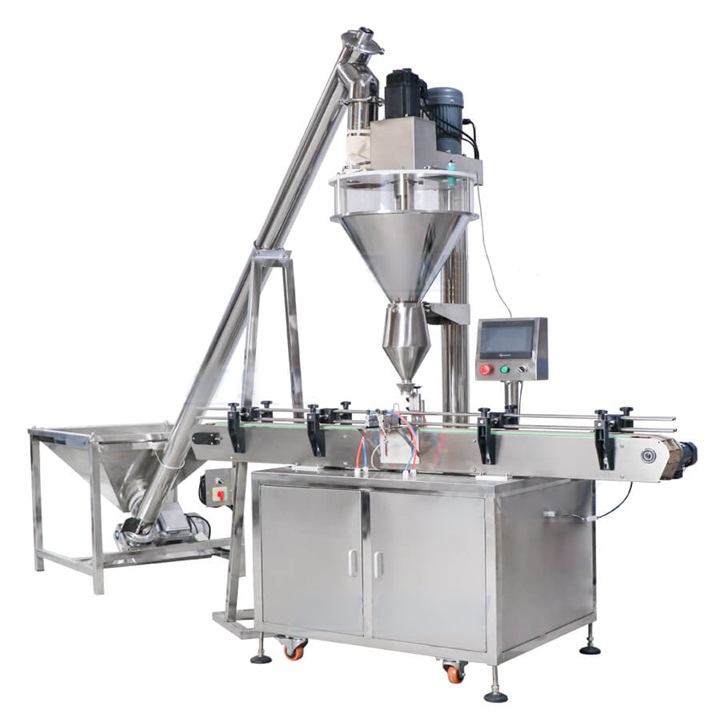
Quantitative filling via set weight or auger revolutions.
Broad dosing window for jars and bottles.
Ref. speed—varies by fill size and powder flow.
Connect to a feeder for automatic supply.
Use as a semi‑auto station to save space.
Helps with sticky powders.
Performance depends on product, container, and setup. Ask us for a timed trial.
Spices, protein, baking mixes.
Supplements and blends.
Detergent and specialty powders.
Tell us about your application. We’ll confirm compatibility and quote the best configuration.
Application and selection guidance
The LUFM730A powder filler shown here combines an auger, hopper mixer, conveyor and integrated weighing. Powder flow, bulk density, dust and the required container are as important as the nominal gram range.
The machine can be run by a target weight or by controlled auger movement. The suitable method depends on the product, required cycle, settling behaviour and how the final quantity is checked.
The page gives an approximate 10–2000 g range. A powder trial is needed to confirm whether the same screw and tooling can cover the required products and doses.
Fine, aerated, sticky or compressible powders can behave very differently from free-flowing granules. Hopper level, mixer action, auger geometry and product replenishment influence consistency.
The 25 litre hopper and mixer described on the page should be considered alongside the batch size, product supply and cleaning requirement.
Provide the container opening, height and stability. The filling outlet must clear the neck while controlling dust and product fall. Where dust extraction or enclosure is required, define the facility and the product handling information.
For multiple powders, review the removal and cleaning of the hopper, screw and product path. If cross-contamination matters, the changeover method should be agreed before manufacture rather than left as an operating assumption.
The stated 30–45 bottles-per-minute figure is a reference and varies with dose, powder flow, container indexing and verification. Use a timed sample trial for the required product and fill.
For free-flowing pieces or products where particle damage and net weight dominate, compare weight filling. For small sachets, the dosing unit may instead be integrated with vertical form fill and seal machinery.
Use a representative powder batch to confirm auger, hopper and weight-control performance.
Request a powder filling reviewNo. The listed range is an equipment reference. Product density, flow, screw size, container and required accuracy determine the practical range for a specific powder.
The mixer helps maintain product movement and a more consistent feed to the auger. Its suitability and speed depend on the powder and should be checked to avoid compaction or damage.
The 30–45 bottles-per-minute figure is a reference. Dose, product flow, weighing cycle, container indexing and replenishment affect sustainable output.
A PTFE auger option is shown on the page, but sticky or cohesive powders still require a sample trial to assess flow, build-up, cleaning and repeatability.
Outlet design, fill height, enclosure, extraction and product feed all contribute. The required control measures depend on the powder and the production environment.
Powder filling project resources
Powders sold under one product name can feed differently after transport, storage, aeration or compaction. A representative bulk sample and controlled test method are therefore essential.
Provide current bulk-density information where available, but also describe cohesion, dust, particles, electrostatic behaviour, compaction and any tendency to bridge or flood. Include the normal and extreme target fills, container or pouch opening, headspace and the approved finished presentation. The hopper, agitator, screw, feed height and extraction or containment needs should be considered as one product path.
For fill-by-weight confirmation, define tare handling, scale resolution, sampling method and acceptable result with the site quality team. Separate short setup cycles from sustained acceptable production that includes replenishment, settling, cleaning and material changes. A trial should use enough product to reach a representative hopper condition and observe the effect of repeated refilling.
Compare auger, vibratory and weight-based routes against product behaviour.
Plan sample quantity, conditioning, measurement and retained evidence.
Control dust, retained material, change parts and first-off release.
Ready to discuss the application?
Send the application details to Lancing for a tailored machinery review.
Powder filling questions
Dry products can change flow with aeration, compaction, humidity and hopper condition. These questions help production teams define the conditions that must be reproduced before an auger or alternative dosing method is accepted.
Hopper level can change the pressure and packing condition of powder above the auger, especially when the product aerates or compacts. A stable setup should therefore be checked at the normal operating range rather than only with a freshly filled hopper.
Record refill method, mixing or agitation, time after loading and the level at which results begin to change. An upstream feed system should maintain a controlled supply without creating a new aeration or segregation problem.
The dry-product dosing comparison explains when another method may be preferable.
Checkweighing should be considered when the finished pack must be verified by mass, when bulk-density variation can change a volumetric dose, or when the process needs documented detection of under- or over-filled packs. The checkweigher does not replace stable dosing; it measures the result and supports control or rejection.
Define tare variation, settling time, conveyor vibration, required data and the response to a failed pack. Feedback correction, if required, should be agreed separately from simple inspection and rejection.
See the coding and inspection guide for reject logic.
Bridging occurs when product forms a stable arch above the outlet; rat-holing occurs when material flows through a narrow channel while product remains around it. Cohesion, moisture, particle shape, hopper geometry, surface condition and compaction can all contribute.
Do not assume that stronger vibration will solve every case. It can compact some powders or cause segregation. A representative trial should observe flow after standing, during refill and at low hopper level, with the actual product batch and handling method.
The powder dosing guide provides a selection framework.
Containment should start by controlling product drop, cut-off and air displacement at the container opening. Local extraction, enclosed transfer or a dust hood may be required, but the arrangement must not remove product from the dose or interfere with weighing and fill stability.
Review occupational exposure, housekeeping, ignition and product-loss risks with a competent site-specific assessment and the product safety information. The machine proposal should state the interface available for extraction rather than implying universal suitability.
Use the safety and compliance planning guide for the wider review.
Provide a sealed product sample, bulk-density and flow observations, dose and container range, refill method and dust-control expectations for a meaningful powder filling review.
Discuss the applicationPowder dosing and pack control
An auger powder-filling trial should include the product at representative compaction, aeration and moisture conditions, the full dose range, container opening, dust-control boundary and the accepted net-quantity process. A short test from a freshly prepared hopper may not represent normal production.
© Copyright 2025 by Lancing Ltd - all right reserved terms & conditions